Avoidance, blame and Saturn’s other side
1/ A RECOGNISABLE SITUATION
I “must” write a series of articles to illustrate my upcoming workshop on Saturn’s Gifts. For several days I have found a plethora of things to do before I can sit down and start what should be an exciting stage of preparation: to pause and think, to use my imagination, to pull the threads of my proposition. I want to take people on a journey into their own experience of time, to help them remember what matters most to them, to their Self, their entire, vital self.
Instead, I have taken on a huge task: upgrading my computer. It means saving everything manually, because I do not want to do it automatically: I am more comfortable when I can “manage and control” how my computer is organised. My reading goes on the back burner, and other things that matter now feel negligible next to my suddenly increased workload.
Other essential tasks creep up. “Shouldn’t I put some thought into the building’s repairs?” After a break-in in the building last week, a neighbour asks whether we should add extra security: major works, and urgently. As a good neighbour and co-owner, I “must” engage with this. My stomach churns at the dent it will make in my budget. Christmas is creeping up too, and although I have freed myself from most obligations, I still love being a doting grandmother, mother and aunt. I need to think, to plan… This goes further: should I make a major change to where I live, help my family, and invest in my own education, something I have wanted to do for a long time?
Little by little the originality of my workshop fades, and simultaneously a wave of anxiety starts building up in my body: my breathing becomes shallower as a weight congeals around my navel, my thoughts become erratic. The ideas that flowed for weeks feel less interesting. The hours of research and the mountain of notes seem pointless. The shadow of doubt grows longer and darker, a full moon shadow, anticipating the entity that will engulf my creativity, my joy, my light, and the gifts I bring back.
I know: my flat needs cleaning! To think straight, it “must” be pristine. Armed with rubber gloves and an arsenal of “organic” cleaning products, I set to work. Several hours later I am tired, and not in a “good” place to do any real work. Tomorrow will be better…
Later, I stop myself as I am about to open a social media platform and watch my peers’ output… and compare myself to them. It would bring a wave of anxiety even bigger than the one I have been trying to “manage”. I have paused my social media presence, which is risky for business. Being stuck reinforces the voice of my tyrannical self: judgemental of others, feeling superior, and at the same time the harshest critic of myself, treating me with utter contempt. Judgement turns to envy, and I feel defeated.
I take a book and light all the candles in my living room. The rain beats against the huge windows, leaving millions of rivulets, wet crystalline paths refracting the lights of the city. It is beautiful, and warm in the amber glow. I breathe. Sanity has come back. As I meditate, I let thoughts emerge and disappear with my breath. Some go back to Saturn.
What is going on?
I avoid, and I blame. Each feeds the other: it is a cycle. The symptoms are easy to see: I overthink, and I distract myself with tasks that are either urgent or trivial. The consequence is inertia. The blame is harder to see, because it arrives not in sequence but all at once.
I have ADD, and this is my experience of it. My mind makes unexpected connections and thinks outside the box, and regulating my attention, my time and my impulses takes constant effort: the hours I spent cleaning, in search of a small dopamine reward, are one example of when it slips. The critic keeps only the second half. A disorganised person, unable to keep a deadline: how can such a person claim any authority? And yet the world gives me little help: I run two websites, a coaching and mentoring practice and my own marketing, alone. Why should it help, I wonder. My computer is hanging on for dear life, which is the world’s fault and my own negligence in the same breath, since I could have attended to it earlier in the year.
My neighbour wants the co-owners to fund major security works. Someone could begin by securing their own flat, the weak link in the break-in. Entitlement, I think, even as the word turns back on me: was I not, a moment ago, demanding that the world cooperate? All the while I feel quietly victimised by well adapted neighbours and more enterprising peers.
Some of this is real: the workload, the failing computer, the break-in. That is what makes the cycle so hard to see. The blame has no fixed address, and each accusation feeds the next. The more I blame, the less I do; the less I do, the more there is to blame. It is a vicious cycle, and it turns fastest when I most need the time and concentration.
Beneath the cycle there is something it protects me from. Jung is often quoted as saying that neurosis is always a substitute for legitimate suffering. I will set the word aside and keep the idea. In the Jungian view as I understand it, under my avoidance there are emotions that must be felt: legitimate emotions that my ego would rather not feel. Sometimes it is fear, and fear can have many objects. Sometimes it is shame, at not being up to the task and failing. And sometimes it is the reluctance to commit and to decide.
These feelings are not an accident. My psyche is demanding that I feel the painful emotions that are coming up and that I am avoiding. Jung called the centre and totality of the psyche the Self, the whole of who I am, whose intention is that I express my potential fully and become the individual I am meant to be: true to myself and full of vitality. For me, that includes furthering my education, something I have wanted for a long time. The avoided feelings are both the price of that and the doorway to it.
Saturn: the other side of the cycle
There are many frameworks for personal development. Astrology is one, and it is both subtle and entirely personal, because it begins with a birth chart: a map of the sky at the moment you drew your first breath. Psychological astrology has long read that chart as the seed of a unique individual. Is it an oak, an apple tree, a reed? James Hillman offered a related image, the acorn: each of us carries the pattern of what we may become. As an astrologer, I understand the chart to be the blueprint of that potential, the pattern the Self is trying to live out.
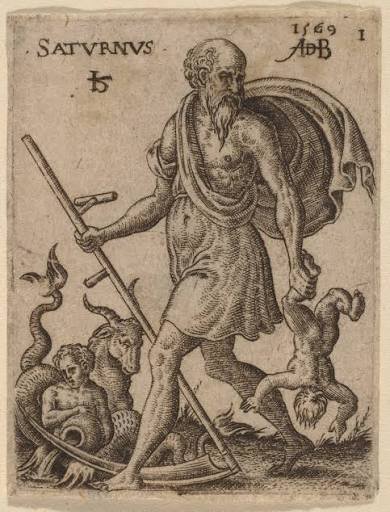
Within the chart, each planet is an archetype: a figure or original pattern that people across cultures have recognised. Saturn, whom the Romans identified with Kronos, is the original energy behind linear time, limits, structure, responsibility, government and authority. Time, and death, are his territory. He is also the guardian at the threshold, who lets nothing through until it has been earned.
Saturn’s sign, house and relationships to the other planets give this shared figure a personal flavour. What I have described above, the avoiding and the blaming, is Saturn at his least conscious: a harsh critic of myself, of others and of circumstances, who shows me where I fear most and where shame can stop me in my tracks. The same energy, made conscious, becomes discernment and authority, humility and mastery: the capacity to do the work that the Self asks of us. It is one Saturn in two states, and the work is to move, little by little, from one to the other.
Five questions to take with you
Choose the one that calls you, and stay with it for a few minutes. Ask it only from a place of curiosity, as a collaborator with yourself, and with compassion towards yourself. If you notice the harsh critic taking over the question, pause and come back to it later.
What am I doing instead?
Whose voice is saying “must”? Is it the tyrannical one, judgemental, patronising, even infantilising: “you must, you should, you ought”? Or the small, quiet, wise one: “this is what needs to be done”?
What happens in my body when I hear “you must, you should, you ought”?
If I stopped blaming, what would I have to do?
What legitimate suffering am I avoiding?
What comes next
This is the first in a short series leading up to the workshop. In the next pieces I turn to authority and its voices, and to time, finitude and death, the ground Saturn guards. In December I am testing the workshop with a small group; details of the public workshop will follow in the new year.